
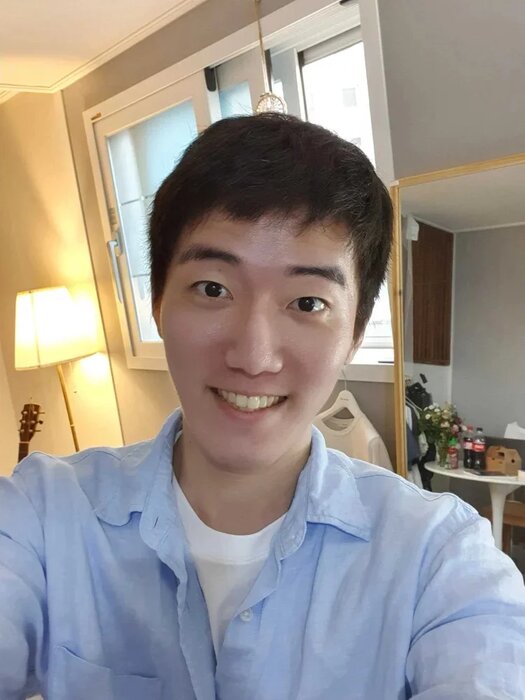
Kyungdo Kim
Multimodal AI for personalized neurology care
PhD Student
Duke University
Your week at a glance
- Small group — you facilitate Group 4 · Aquila on Day 4 (Methods & modeling).
- Job talk — Day 6 (Sat, Jun 27), 9:55 AM · Room A · Alder 107 — “From Physical Body to Digital Human: Quantitative Assessment of Human Movement for Neurological Disorders”.
- Poster — Day 7 (Sun, Jun 28) · Session A (9:15–10:15 AM).
Kyungdo Kim is a fourth-year Ph.D. candidate in Biomedical Engineering at Duke University, where he leads the TULIP project, a multimodal AI system for quantitative assessment of neurological disorders, including Parkinson's disease. His research integrates markerless multi-camera 3D pose estimation, EHR modeling with heterogeneous disease progression, and explainable AI to bridge the gap between clinical scoring and continuous behavior measurement. He has authored multiple publications spanning diverse healthcare data modalities including vision, audio, biosignals, clinical NLP, and EHR, with a first-author CVPR 2024 paper among them. Beyond academia, Kyungdo interned at Samsung Research America during his Ph.D. and previously co-founded a hardware startup as CTO, building IoT and AI systems from the ground up. His long-term vision is a "physical human to digital human" framework that captures and quantifies the full spectrum of human data across movement, physiology, and behavior to enable personalized healthcare.
Awards & honors
Recognition
- KSEA-KUSCO (Korea-U.S. Science Cooperation Center) Graduate Scholarship (2025)
- Doctoral Symposium Travel Award, Association for Health Learning and Inference (CHIL 2025) (2025)
- Asan Medical Center Fellowship (2022-2024)
- Duke Fellowship (2022)
- Excellence in Teaching Award, Seoul National University (2020)
- National Scholarship for Science and Engineering (full funding), South Korea (2015-2016)
- Scholarship for Academic Excellence (merit-based), Seoul National University (2014)
- Young Investigator Award Finalist, International Congress on Pediatric Pulmonology (2022)